Robotics Systems Engineer · Noida, IN

Off-the-shelf
body. From-scratch
mind.

A Unitree G1 arrives as hardware and an SDK. The layer that turns it into a system is mine: the coordinator, the safety path, the bridge that drives it, voice, behaviour. Torn down and rebuilt five times. Four years of surgical-robot motion control came first. That's it in the video.

0
single-author commits · the software stack
0
DOF under command
0
voice-to-action, on-device
0
SCHED_FIFO safety thread, prio 90
01 · The humanoid

One robot. Five rebuilds.
One author on the stack.

A Unitree G1 with Inspire dexterous hands, 41 degrees of freedom, on a four-person programme where the software is mine: 1,841 commits, single author, torn down and rebuilt five times. Monolithic proof-of-concept to split-compute dual-Jetson platform, with a behavior-tree coordinator, a safety thread that outranks everything, and a voice pipeline that never leaves the robot. All of it on hardware, none of it sim-only.

6,900 LOC
C++ coordinator · BehaviorTree.CPP v4 · 3 SCHED_FIFO threads
100 Hz
SCHED_FIFO prio-90 safety monitor · pinned core · watchdog fail-safe damp
1,062
tactile taxels per hand · full Modbus sensor pipeline, test-asserted against the datasheet
932 +37
pytest cases + C++ test files · 113+ bugs tracked & fixed in-repo
RT systems

The spine: behavior trees over DDS, with a safety thread that outranks everything

Priority arbitration Emergency > Teleop > Voice > Autonomous > Idle in a BehaviorTree.CPP v4 coordinator. Joint commands stream at the 500Hz rate the DDS bus requires; hand control publishes at 100Hz; processes exchange state over a hand-rolled lock-free seqlock shared-memory interface, memory_order_acquire and all. Safety is its own 100Hz SCHED_FIFO thread on a dedicated core: IMU pitch/roll envelopes, thermal and battery thresholds, heartbeat watchdog that drops the robot to damped mode on a 3-miss.

Edge voice AI

A robot you talk to, fully offline, audio to audio

Whisper large-v3-turbo INT8 → a custom fine-tuned 14B LLM → Kokoro TTS. The pipeline was originally squeezed onto a 16GB Orin NX (three models sharing one GPU via lock scheduling), and now runs on an AGX Orin 64GB with room to breathe. Every model earned its slot in a head-to-head shootout harness. The 14B runs custom speculative decoding (draft model, batched verify, KV realignment) written from scratch. Tag-routing beat LLM tool-calling by a measured 690ms per turn. Barge-in at 200ms. It also knows who is speaking: a C++ speaker-ID pipeline (Silero VAD → TitaNet embeddings, temporal evidence gating).

Autonomous nav

Walked it to a goal, then spent the month making it refuse to

The chain came up end to end on hardware: a goal set 1.5m out and 90° off heading, the robot aligned, walked 1.10m, and stopped within 10cm of it, eyes on, gantry-suspended. My half is the bridge from planner to motors and everything guarding it, which is where the month actually went. Velocity and yaw-rate shaping under caps. Fail-closed on stale localization, measured at 1.53s from kill to emergency stop. No state feed publishes nothing but zeros. Armed only by an explicit flag, disarmed by default, walked up a rung ladder where every step needed a human to say go. The planner itself (A*, elastic band, pure pursuit) is an existing stack I drive, not one I wrote.

Manipulation

Found a silent MoveIt bug; fixed it with measured receipts

A 500Hz DDS bridge (2ms timer) with cubic-Hermite interpolation feeding 15 motion planners. MoveIt's velocity scaling was silently a no-op, traced to the source, then fixed by rescaling trajectory timestamps directly: a measured 10× execution-duration range from the same planned path.

02 · From the optimization log

Measured, or it
didn't happen.

Git-committed before/after numbers from the voice stack. The wins came from KV-cache reuse, sentence-level LLM/TTS interleaving, and GPU-lock scheduling, not bigger hardware.

one turn · audio → audio · representative trace ● LIVE
Pipeline
Before
After
Δ
End-to-end voice reply (chat)
5.5s
2.9s
−47%
RAG-grounded reply
9-10s
5.6-6.0s
−41%
TTS per sentence
2,000ms
300-360ms
−83%
Intent routing vs tool-calling
n/a
−690ms
per turn, measured
03 · Where the discipline came from

Before the humanoid,
an operating room.

Four years on SSi Mantra, India's first surgical robot, a 12-DOF cart. Motion control on its arm: cascaded PID with feed-forward, gain scheduling across the workload envelope, friction compensation for surgical-grade smoothness at sub-millimeter scales. Hands deep in harmonic drives, ELMO and Ingenia servo controllers, Bode/Nichols on the bench for 7+ joints.

EtherCAT, by hand

A pySOEM-based EtherCAT stack: DS402/CiA 402 state machines, drive commissioning, characterisation routines for a friction-compensation rig. I wrote the master. Every byte on the bus accounted for.

Medical-grade means paranoid

Harnessing layouts, calibration procedures, repeatability and system-level safety compliance, the unglamorous work that lets a robot pass medical scrutiny. That paranoia is now the humanoid's safety architecture.

Soft robots, no bones

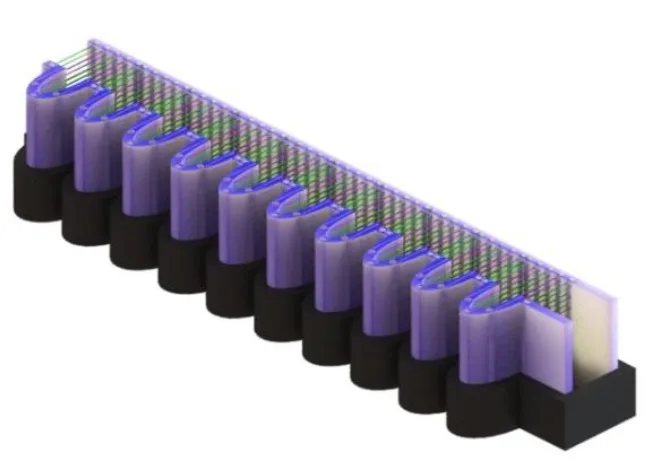
At NUS with Dr. Marcelo Ang's lab: asymmetric bending baked into the material itself: two elastomers cured as a viscosity gradient. Springer IAS 2022. An IEEE hexapod paper before that.

Gradient soft pneumatic actuator array, CAD render from the paper
Fig: gradient soft actuator array · Springer IAS 2022 · w/ NUS
04 · Paper trail

Receipts.

Experience

JAN 2025 - NOW
Sr. Mechatronics Engineer · SS Innovations
Humanoid software stack (lead of three) + motion control across a 20+ engineer org.
MAY 2022 - DEC 2024
Mechatronics Engineer · SS Innovations
Harnessing, calibration, DFM for medical-grade actuators on the surgical platform.
JUN 2021 - MAY 2022
Robotics Software Intern · SS Innovations
Early controls software for the surgical platform.
FEB - JUN 2020
Research Intern · NUS, Dr. Marcelo Ang's Lab
Soft pneumatic actuators; squid-inspired soft robot locomotion.

Education · Publications · Honors

2020 - 2022
M.Tech Robotics · DIAT (DRDO), Pune
GPA 8.05/10 · thesis on motion control of medical-grade actuators.
SPRINGER · IAS 2022
GradNet: viscosity-gradient soft pneumatic actuators
IEEE · ICCAR 2020
Amphibian hexapod with computer vision for rescue ops
2018 · PITTSBURGH
ASME Student Design Competition, World Rank 10
Asia-Pacific champions → world finals.
Finis

Say hello.

If any of this resonated (the humanoid, the bus, the bends without bones), write to me.

tanaymisra97@gmail.com → LINKEDIN GITHUB RESUME.PDF
© 2026 Tanay Misra · Noida, IN